CÓMO PUEDE SER QUE EL BOLETÍN EPIDEMIOLÓGICO ARGENTINO DIGA QUE PRÁCTICAMENTE NO HAY COVID (SÍ UNAS 13O MUERTES SOSPECHOSAS POR "GRIPE") Y QUE EN ESTE PRESTIGIOSO MEDIO DE SALUD MUNDIAL DIGA LO CONTRARIO?
LEEMOS EN EL ARTÍCULO:
"Una vez más, extrañamente, los principales medios de comunicación locales del país no cubren ningún informe sobre la situación del COVID-19 que se desarrolla en el país."
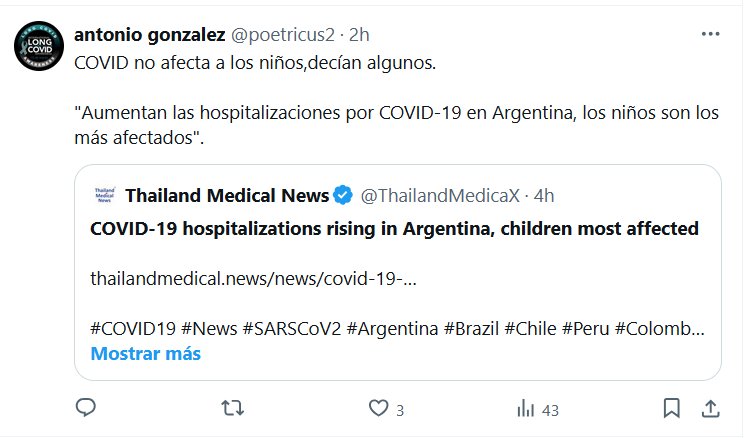
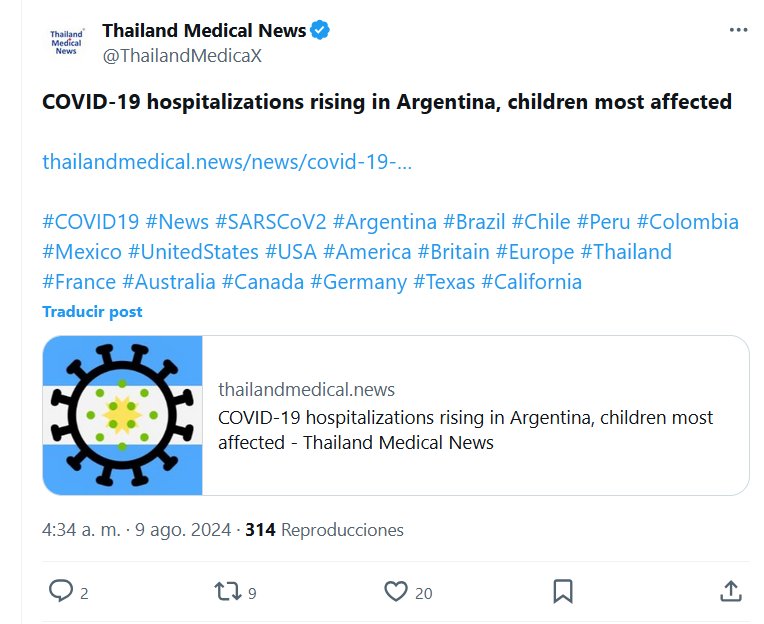
https://x.com/ThailandMedicaX/status/1821812272236519483

TEXTO ORIGINAL Y TRADUCIDO POR GOOGLE
Pediatric Hospitalizations on the Rise
One of the most concerning aspects of the recent data is the significant number of pediatric hospitalizations. A total of 213 children aged 0 to 17 years were hospitalized due to COVID-19 during this period, representing a rate of 1.74 hospitalizations per 100,000 inhabitants. Particularly alarming is the rate among infants under one year of age, where 103 hospitalizations were recorded, equating to a staggering 21.02 per 100,000 inhabitants.
Once again strangely, the local mainstream media in the country are not covering any reports of the COVID-19 situation developing in the country.
This high rate among the youngest population suggests that despite earlier beliefs that children were less susceptible to severe forms of the virus, COVID-19 continues to pose a serious threat to this vulnerable group. The situation calls for increased vigilance and possibly targeted interventions to protect infants and young children from the virus.
No one is able to determine what SARS-CoV-2 variants are driving the surge in Argentina as there is extremely low or non-existent genomic surveillance in the country.
https://cov-spectrum.org/explore/Argentina/AllSamples/Past6M/sequencing-coverage
Hospitalizaciones pediátricas en aumento
Uno de los aspectos más preocupantes de los datos recientes es el importante número de hospitalizaciones pediátricas. Un total de 213 niños de 0 a 17 años fueron hospitalizados a causa de la COVID-19 durante este período, lo que representa una tasa de 1,74 hospitalizaciones por cada 100.000 habitantes. Particularmente alarmante es la tasa entre los menores de un año, donde se registraron 103 hospitalizaciones, lo que equivale a la asombrosa cifra de 21,02 por 100.000 habitantes.
Una vez más, extrañamente, los principales medios de comunicación locales del país no cubren ningún informe sobre la situación del COVID-19 que se desarrolla en el país.
Esta alta tasa entre la población más joven sugiere que, a pesar de las creencias anteriores de que los niños eran menos susceptibles a las formas graves del virus, la COVID-19 sigue planteando una grave amenaza para este grupo vulnerable. La situación exige una mayor vigilancia y posiblemente intervenciones específicas para proteger a los bebés y niños pequeños del virus.
Nadie puede determinar qué variantes del SARS-CoV-2 están impulsando el aumento en Argentina, ya que la vigilancia genómica en el país es extremadamente baja o inexistente.
https://cov-spectrum.org/explore/Argentina/AllSamples/Past6M/sequencing-
Adult and Elderly Hospitalizations: A Diverse Impact
The data for adults and elderly individuals shows a more varied impact, with 207 hospitalizations recorded for those aged 18 years and above, translating to 0.61 hospitalizations per 100,000 inhabitants. When broken down further, 59 of these cases were among those aged 18 to 49 years (0.27 hospitalizations per 100,000), and 148 cases were recorded in individuals aged 50 and above (1.22 hospitalizations per 100,000).
Elderly individuals, especially those over 80 years old, also faced significant risks, with 47 hospitalizations in this age group, which amounts to 3.73 hospitalizations per 100,000 inhabitants. This data underscores the continued vulnerability of older populations to COVID-19, even as the pandemic progresses.
Recent Weekly Report: A Worrying Trend
In the last week of data collection (SE31/24), Argentina recorded 113 new cases of COVID-19, of which 54 required hospitalizations. This represents an increase of 8 hospitalizations compared to the previous week, indicating a potential upward trend in severe cases. />
The breakdown of these 54 hospitalizations shows the following distribution:
-13 hospitalizations involved children under one year of age, an increase of 3 from the previous week.
Hospitalizaciones de adultos y ancianos: un impacto diverso
Los datos para adultos y personas mayores muestran un impacto más variado, con 207 hospitalizaciones registradas para personas mayores de 18 años, lo que se traduce en 0,61 hospitalizaciones por 100.000 habitantes. Si se desglosa más, 59 de estos casos ocurrieron entre personas de 18 a 49 años (0,27 hospitalizaciones por 100.000) y 148 casos se registraron en personas de 50 años o más (1,22 hospitalizaciones por 100.000).
Las personas mayores, especialmente las mayores de 80 años, también enfrentaron riesgos importantes, con 47 hospitalizaciones en este grupo de edad, lo que equivale a 3,73 hospitalizaciones por cada 100.000 habitantes. Estos datos subrayan la continua vulnerabilidad de las poblaciones de mayor edad al COVID-19, incluso a medida que avanza la pandemia.
Informe semanal reciente: una tendencia preocupante
En la última semana de recolección de datos (SE31/24), Argentina registró 113 nuevos casos de COVID-19, de los cuales 54 requirieron hospitalización. Esto representa un aumento de 8 hospitalizaciones respecto a la semana anterior, lo que indica una potencial tendencia al alza en los casos graves. />
El desglose de estas 54 hospitalizaciones muestra la siguiente distribución:
-13 hospitalizaciones involucraron a niños menores de un año, un aumento de 3 respecto a la semana anterior.
-9 hospitalizations were in the age group of 1 to 9 years, a decrease of 2 from the previous week.
-6 hospitalizations were among individuals aged 10 to 49 years, also a decrease of 2.
-9 hospitalizations were in the 50 to 69 years age group, an increase of 6.
17 hospitalizations were recorded in those over 70 years of age, an increase of 3 from the previous week.
Deaths: A Grim Reminder
The report also highlights the tragic loss of life due to COVID-19. In the same week, 9 deaths were reported, 8 of which were recorded in the Autonomous City of Buenos Aires (CABA), with 7 being delayed reports. Notably, among the deceased were 3 children under 2 years of age who succumbed to the virus on 11th February, 14th May, and 30th July 2024.
-9 hospitalizaciones se produjeron en el grupo de edad de 1 a 9 años, una disminución de 2 respecto a la semana anterior.
-6 hospitalizaciones se produjeron entre personas de 10 a 49 años, también una disminución de 2.
-9 hospitalizaciones correspondieron al grupo de edad de 50 a 69 años, un aumento de 6.
Se registraron 17 hospitalizaciones en mayores de 70 años, un aumento de 3 respecto a la semana anterior.
Muertes: un sombrío recordatorio
El informe también destaca la trágica pérdida de vidas debido al COVID-19. En la misma semana se reportaron 9 muertes, 8 de las cuales se registraron en la Ciudad Autónoma de Buenos Aires (CABA), y 7 fueron reportes retrasados. Cabe destacar que entre los fallecidos se encuentran 3 niños menores de 2 años que sucumbieron al virus el 11 de febrero, el 14 de mayo y el 30 de julio de 2024.
Conclusion: The Path Forward
The recent data from Argentina serves as a stark reminder that COVID-19 remains a formidable challenge. The rise in hospitalizations, particularly among infants and the elderly, underscores the need for continued vigilance and targeted public health measures.
As Argentina navigates through these troubling times, the healthcare system's ability to respond to these surges will be critical in preventing further loss of life and mitigating the impact of the virus. The country must stay informed and prepared, with the latest updates and strategies to combat this persistent threat.
For more detailed and up-to-date information, please refer to the latest studies and reports published in peer-reviewed journals and stay informed and vigilant by following the updates on Thailand Medical News.
Data Sources:
https://threadreaderapp.com/thread/1820205097239949416.html
https://x.com/CoronavirusArgg/status/1820195145880310239
Read Also:
https://www.thailandmedical.news/news/south-korea-sees-sixfold-surge-in-covid-19-hospitalizations-amid-summer-resurgence
https://www.thailandmedical.news/news/breaking-parts-of-china-witnessing-a-covid-19-resurgence-driven-by-a-new-recombinant-delta-and-omicron-variant-xdv-1
Conclusión: el camino a seguir
Los datos recientes de Argentina sirven como claro recordatorio de que la COVID-19 sigue siendo un desafío formidable. El aumento de las hospitalizaciones, especialmente entre los bebés y los ancianos, subraya la necesidad de una vigilancia continua y de medidas de salud pública específicas.
Mientras Argentina atraviesa estos tiempos difíciles, la capacidad del sistema de salud para responder a estos aumentos repentinos será fundamental para evitar más pérdidas de vidas y mitigar el impacto del virus. El país debe mantenerse informado y preparado, con las últimas actualizaciones y estrategias para combatir esta persistente amenaza.
Para obtener información más detallada y actualizada, consulte los últimos estudios e informes publicados en revistas revisadas por pares y manténgase informado y atento siguiendo las actualizaciones en Tailandia Medical News.
Fuentes de datos:
https://jorgealiaga.com.ar/?page_id=2185
https://threadreaderapp.com/thread/1820205097239949416.html
https://x.com/CoronavirusArgg/status/1820195145880310239
Lea también:
https://www.thailandmedical.news/news/south-korea-sees-sixfold-surge-in-covid-19-hospitalizations-amid-summer-resurgence
https://www.thailandmedical.news/news/breaking-parts-of-china-testigo-a-covid-19-resurgence-driven-by-a-new-recombinant-delta-and-omicron-variant-xdv- 1
Ícono de validado por la comunidad
FUENTE: